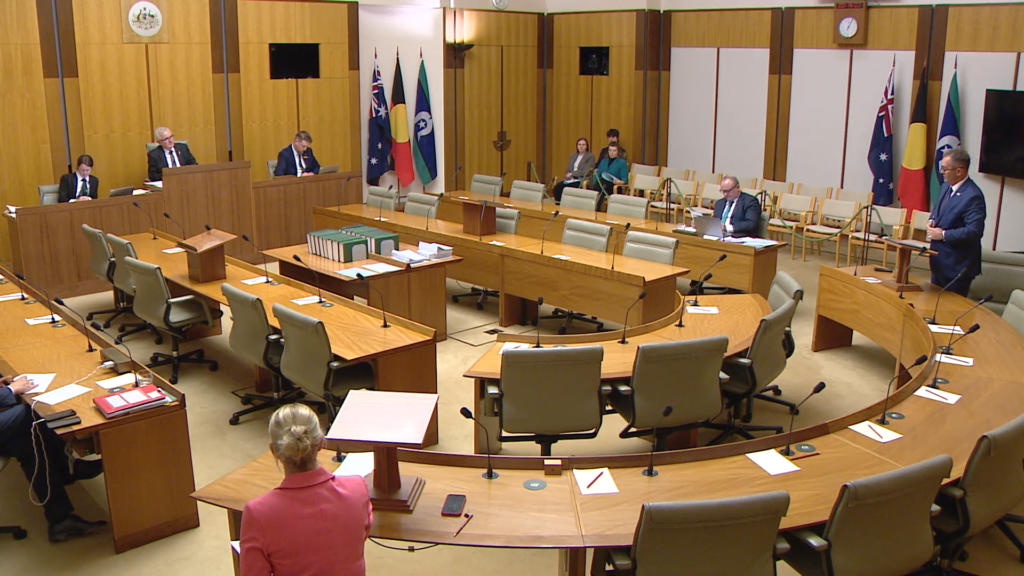
Federation Chamber | 18 August 2026
Mr WALLACE (Fisher) (18:38): Australians were promised a better administrative review system. As a lawyer, a barrister of some 26 years now or thereabouts, I understand the importance of administrative review. Australians were promised that abolishing the Administrative Appeals Tribunal and replacing it with Labor’s new Administrative Review Tribunal would deliver a system that was fairer, more efficient and better equipped to deal with its case load. Around a billion dollars later, less than two years after the new tribunal commenced operation, parliament is back here again fixing this bill—more amendments, more repairs, more powers being added, more procedures being corrected and a tribunal now carrying a case load of more than 131,000 matters.
The coalition will support this bill because it contains some sensible measures to improve the operation of the Administrative Review Tribunal and help address significant pressure in our migration review system. Where legislation improves efficiency, removes duplication and allows appropriately qualified people to get on with the job, we’ll support it. But Labor should not pretend this bill has appeared in some sort of vacuum. The former attorney-general abolished the AAT, committed a billion dollars to establishing its replacement and dealing with associated pressures in the migration system and told Australians the new system would be better. Australians were entitled to expect that, after spending that sort of money, this government would get it right. Instead, parliament is here yet again being asked to clean up this mess.
The Administrative Review Tribunal commenced operation on 14 October 2024. Since then, parliament has dealt with the original establishment legislation, miscellaneous measures, further amendments and now this bill. The government has also committed another $69 million to continue dealing with this tribunal backlog—because that’s what it is facing: a backlog. Australians were entitled to expect that, after around a billion dollars had been committed to creating a new system, it would be settled and operationally effective. Instead, less than two years later, parliament is again being asked to correct emissions, expand powers and improve procedures.
The numbers tell the story. As at 31 May this year the tribunal had more than 131,000 cases on hand. Just five years earlier that figure was around 65,000. The caseload has effectively doubled. The median time taken to finalise an application has increased by 22 weeks, and just 43 per cent of applications are being finalised within 12 months of lodgement. Anyone who has worked in the legal system understands what that means. A backlog is not just a statistic. Behind every unresolved matter is someone waiting for certainty, is someone who doesn’t sleep at night, is someone who is aggrieved by a decision from a government department. Justice delayed is justice denied.
Before entering this parliament, I spent 16 years working as a barrister. I’ve seen firsthand what happens when disputes become unnecessarily complicated and unnecessarily prolonged. Good legal and administrative systems must be fair, but they must also be efficient. Those principles are not mutually exclusive. A system that makes decisions quickly but unfairly is unacceptable, but a system where people wait years for an outcome is not delivering justice either. Governments have a responsibility to design systems that reach proper decisions while using taxpayers’ resources responsibly. That’s why the coalition supports the practical measures in this bill.
One of the key reforms is to expand the powers the president of the tribunal may authorise the registrar to exercise. These include dismissing an application where there are no reasonable prospects of success, requiring leave before specified further applications can be made and reinstating an application where the registrar has authority to dismiss it. These are sensible reforms. Tribunal members are a finite resource. Every hour a tribunal member spends dealing with a procedural issue that could appropriately be handled by a qualified registrar is an hour they cannot spend determining a substantive matter. We need the right people doing the right work. Importantly, there are safeguards. The president can impose conditions on an authorisation, and mechanisms remain available for applications to be reinstated where appropriate. At the end of July, the tribunal had 112 registrars, and more than nine in 10 held qualifications in law, dispute resolution or both. We’re talking about appropriately qualified people exercising clearly defined powers.
But with additional power must come additional responsibility and accountability. If parliament gives registrars greater authority, parliament should know whether those powers are working. How many applications are being dismissed? How many decisions are being overturned? Are the tribunal’s powers reducing the backlog? Are the current rules freeing tribunal members to deal with substantive matters? That’s why the coalition will pursue an amendment in the Senate to strengthen annual reporting—because we’ve got to know the answers to these important questions. Governments are very good—this Labor government in particular is very good—at making announcements. They’re very good at talking the talk. But the real test is when the rubber hits the road. Parliament should be able to assess the results and determine whether taxpayers are getting a better functioning tribunal.
The bill also contains a number of practical improvements which the coalition supports. It will require specified migration and protection review applications to use an approved form. It will also allow appropriate migration decisions and reasons to be given orally. It removes unnecessary duplication in notifications to the Department of Home Affairs. It introduces identity-verification requirements in prescribed migration matters. It restores the standard 28-day review period for certain taxation decisions. And it makes it easier to correct particular obvious errors. None of those measures alone will solve a backlog of more than 131,000 cases. But, taken together, sensible procedural changes can reduce unnecessary work and allow the tribunal to focus resources on where they are needed most.
The bill will allow tribunal members, in appropriate migration matters, to give their decisions and reasons orally, rather than requiring written reasons in every instance. They will continue to be required in specified categories, including social security, veterans entitlements, aged care and NDIS matters. And, boy, let me tell you, Deputy Speaker Wilkie, there are a lot of NDIS matters before the tribunal. I understand, just for the sake of it, that around 80 per cent of matters involving the NDIS that are going to the tribunal are overturning the decisions of the NDIA—around 80 per cent. That’s something where this government needs to take a very long, hard look at itself.
The 35-day period for seeking judicial review will run from notification of the oral decision. An applicant will ordinarily have 14 days to request written reasons, and the tribunal will ordinarily have 14 days to provide them. That strikes what we consider to be an appropriate balance. People must have a genuine opportunity to understand and challenge a decision where the law allows. But proceedings must also eventually reach a conclusion. That is a fundamental tenet of our justice system.
Another important reform is the introduction of identity-verification requirements for prescribed migration and protection applicants who are not in immigration detention. At tribunal level, an application must be dismissed where an applicant fails to comply with the prescribed requirement. That’s reasonable. If somebody is asking Australia’s migration review system to reconsider a decision affecting their status in this country, Australians have every right to expect that that person is who they say they are. That’s not unreasonable. It’s a basic expectation. Our migration system must have that kind of integrity. Applicants seeking the benefit of that system must genuinely engage with it, and the tribunal must be able to establish the identity of the person seeking review. Every unnecessary delay in a migration matter has consequences. It consumes tribunal resources, it consumes departmental resources, it costs taxpayers’ money, and it delays other people who may have legitimate and complex cases requiring proper consideration. Australians expect the government to know who’s coming to this country, why they’re here, whether they are entitled to remain and whether our migration laws are being properly enforced. Administrative review is an important safeguard but review cannot become an excuse for endless process. Fairness requires proper review. Integrity requires some degree of finality.
There’s another provision in this bill which says a lot about the quality of Labor’s original ART legislation. The bill restores the standard 28-day period for seeking review of certain decisions by the Commissioner of Taxation, refusing an extension of time. Why does that need fixing, I hear you ask, Mr Deputy Speaker Wilkie? It is because that standard review period was not properly carried across when Labor abolished the AAT and established the ART. After the enormous cost of Labor’s restructure, a basic review period still fell through the cracks. Administrative law is built on technical provisions because those provisions determine real rights and real obligations. When a government tears down an established system and rebuilds it, it assumes responsibility for getting those details right, and Labor didn’t, so, once again, parliament is being asked to fix it.
The coalition also believes there is another practical reform the government should consider. We’ll move an amendment in the Senate asking the government to consider a further amendment to deal with clear and objectively identifiable administrative errors or oversights in migration decisions.
Now, common sense needs to prevail when it comes to administrative law and when it comes to the Administrative Review Tribunal. If everyone can see that an obvious administrative mistake has been made, why force the applicant, the department and the tribunal through the machinery of a substantive merits review outcome simply to correct it? Fix the mistake quickly, save tribunal resources, save department departmental resources and allow the next person in the queue to have their matter heard sooner. That’s not weakening administrative review; it’s making it work.
Now, Labor cannot rewrite history. The coalition is taking a constructive approach to this bill. Where it improves efficiency, we will support it. Where it gives appropriately qualified registrars sensible powers, we will support it. Where it removes duplication, we will support it. Where it strengthens identity verification and the integrity of migration review, we will support it. But our support does not give Labor permission to rewrite the history of how we arrived here. Labor abolished the AAT and it cost Australian taxpayers around $1 billion to do it, and now we’re fixing up their constant mistakes. (Time expired)
[ENDS]
Media Contact: Brendan West – 0402 556 646 – Brendan.west@aph.gov.au